Every listing arrives with a number. The price guide is the agent’s number, set to bring buyers through the door and to start the negotiation where the vendor wants it. Before you offer you need three numbers of your own, and a read of four council overlays that can change what the property is worth to you. Done well, that read takes a minute. This guide shows the minute, with every figure worked.
The guide is not your number
Why the first figure you see is the last one to trustA guide does one job: it gets you to the inspection. In a rising campaign it sits under where the vendor expects to sell. In a tired campaign it gets cut to restart interest. Either way it tells you about the campaign, not about the property. The only number that tells you about the property comes from what comparable homes have actually sold for, and the only numbers that protect you are the two you set around it.
So the first minute is spent getting three figures of your own onto the page. Everything else follows from them.
Three numbers, worked
A $1,120,000 house on the Sunshine CoastTake a three-bedroom house in Maroochydore. Four comparable sales within a kilometre in the last four months give an estimate of $1,120,000. The sources give that single figure and no low or high range.
Step 1. The estimate. $1,120,000, from the sales, not the guide.
Step 2. The opening offer. With no sourced range, open 1% under the estimate.
Opening offer : $1,120,000 × 0.99 = $1,108,800Step 3. The walk-away. With no sourced range, stop 5% over the estimate.
Walk-away : $1,120,000 × 1.05 = $1,176,000Three numbers, in order: $1,108,800 · $1,120,000 · $1,176,000. The gap between the first and the last is $67,200, and that gap is the whole negotiation. Anything above the last number is a different property at a price you decided, in advance, not to pay.
Now the same read on a house in Preston where the sources do give a range: an estimate of $845,000 with a low of $810,000 and a high of $880,000. Here nothing is derived. The opening offer is the low end of the sourced range and the walk-away is the high end.
Opening offer   : $810,000   (sourced low)
Estimate        : $845,000
Walk-away       : $880,000   (sourced high)
Negotiating gap : $880,000 − $810,000 = $70,000
The 5% walk-away premium is the medium-confidence tier from the offer guide: 3% when fifteen or more clean comparables agree, 5% with eight to fourteen, 8% with fewer than eight or a wide spread. With only four sales behind the Maroochydore estimate, the guide’s own tier would be 8%, so treat the derived 5% as the tighter of the two and find more sales before you lean on either.
Derived or sourced
The one line that keeps the read honestThe two reads above look alike and are not. In Maroochydore the offer and the walk-away are derived from the estimate: rules of thumb, applied to one figure. In Preston they are sourced: the low and the high came from the data. A read that does not tell you which is which invites you to treat a rule of thumb as a fact, and that is how a walk-away drifts $30,000 on auction day.
So the read says it, in words, every time: “Opening offer 1% under the estimate; walk-away 5% over. Derived from the estimate, not from sales.” When you see that line, your next job is to find the sales yourself and replace the rule with a range.
Four overlays, three words
What each one is, and what to do with itThe numbers say what the property is worth. The overlays say what it will cost you to own, build on, insure or sell. Four of them are facts recorded against the lot, and each gets one of three words.
| Overlay | What it is | Check | Noted | Clear |
|---|---|---|---|---|
| Bushfire attack level | One of six levels in the Australian standard for building in bushfire-prone areas, from BAL-LOW to BAL-FZ. The number is the radiant heat, in kilowatts per square metre, the building must withstand. | A rating at BAL-29 or above: ask for the assessment, price any extension at that construction level, get an insurance quote before you offer. | A rating below BAL-29: note it for any future building work. | No bushfire-prone designation on the lot. |
| Flood overlay | A council planning overlay marking land a mapped flood can reach. It changes insurance, building conditions and resale. | A high-status overlay on the lot: insurance quote and the council flood information before any offer. | An overlay touching part of the lot at a lower status: confirm the house itself sits outside it. | No overlay on the lot. |
| Heritage | A listing or overlay that restricts demolition and external changes. | A listing you did not expect on a house you planned to change. | A listing on a house you plan to keep as it is. | Not listed. |
| Flight path | An airport noise contour over the lot. Affects liveability, tenants and resale, and can bring acoustic building requirements. | A contour at a level that triggers building conditions. | A contour on the lot: inspect at the busiest flying hours. | Not under a contour. |
On the Maroochydore house the read comes back BAL 29: check. Medium flood: noted. No heritage: clear. Flight path: noted. One thing to settle before an offer, two to carry into the inspection, one to forget. The order of the afternoon writes itself.
A guide under every sale
The second worked example: $1,250,000 against four salesBack to the sales behind the Maroochydore estimate: $1,310,000, $1,360,000, $1,410,000 and $1,460,000. Now put the campaign’s guide beside them: $1,250,000.
Lowest sale     : $1,310,000
Guide gap       : ($1,310,000 − $1,250,000) ÷ $1,310,000 = 4.6% under the lowest sale
Median sale     : ($1,360,000 + $1,410,000) ÷ 2 = $1,385,000
Guide gap       : ($1,385,000 − $1,250,000) ÷ $1,385,000 = 9.7% under the median
A guide that sits under every comparable sale is not a discount. It is a question for the agent: what offers has the campaign had, and how long has it been running? Ask it, then anchor every number you write to the sales. The guide has already done its job by getting you to the door.
Reading the card
The minute, on one screenAsk Heyward about an address and the read lands under your question in this order: the address and the date the data was checked, one sentence that says what to do, then the three numbers on a single line with the estimate between the opening offer and the walk-away, then each overlay with its word, then the sources and comparable sales behind it all.
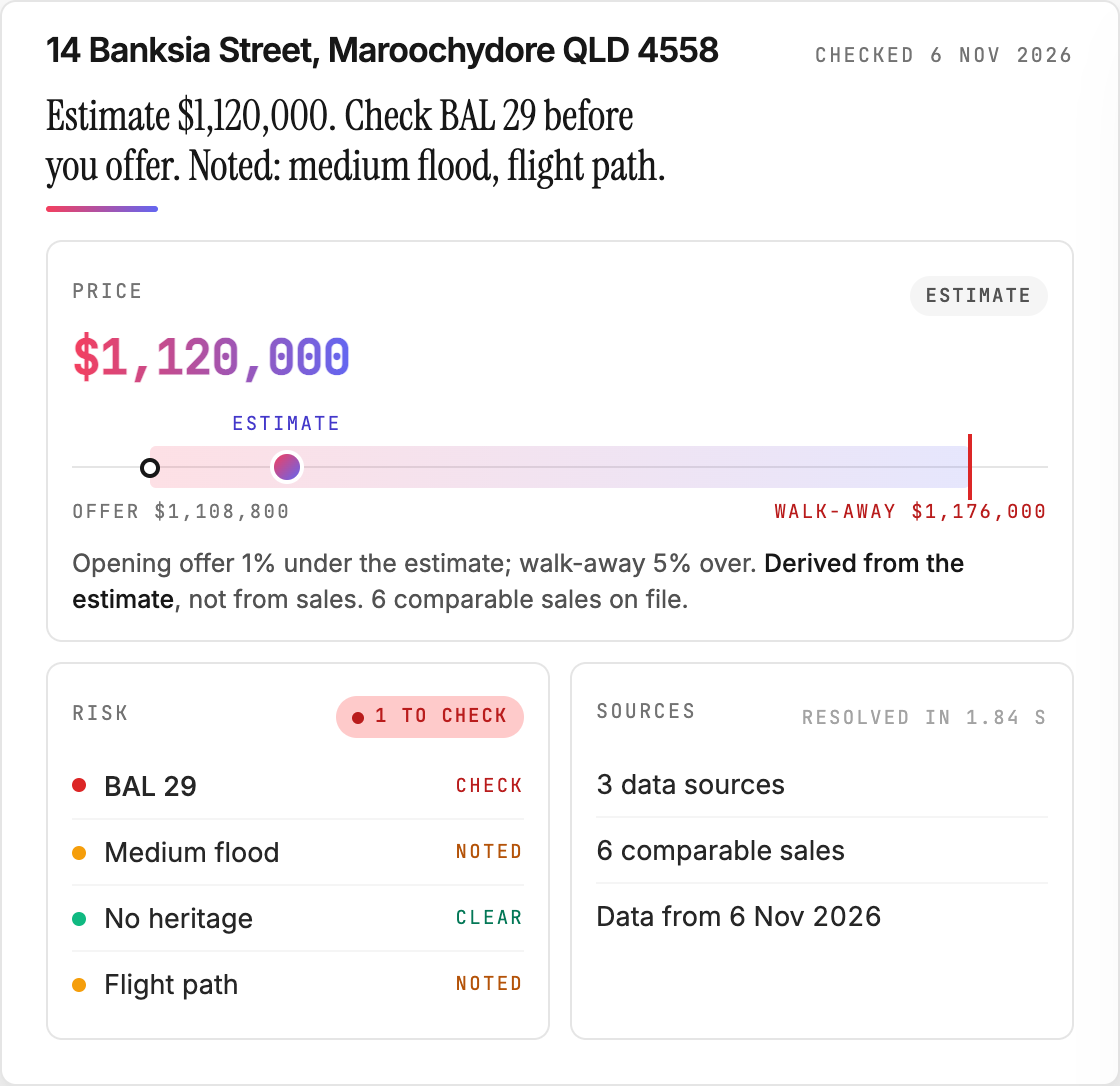
Read it top to bottom once. The sentence tells you whether to make a call before you make an offer. The band tells you where to start and where to stop. The words tell you what the afternoon is for. The sources tell you how much to trust the rest.
The method above does not change between properties. What changes is the data, and that is what Heyward runs for you when you name an address.
- Three numbers on one line. The estimate between the opening offer and the walk-away, from the same comparable-sales method every time.
- It says when a number is derived. No sourced range, no pretending: the card tells you the offer and walk-away are rules of thumb on the estimate.
- Four overlays, three words. Bushfire rating, flood, heritage and flight path, each marked check, noted or clear, with the date the data was checked.
- You keep every decision. Heyward reads; you offer.
The guide is the agent’s number. The minute above gives you yours, and it gives you the same minute on the twentieth property as on the first.
Free to start. Start free →
Questions
Short answersWhat are the three numbers I need before I offer?
An estimate from comparable sales, an opening offer under it, and a walk-away above it, decided before negotiation starts. On a $1,120,000 estimate with no sourced range: $1,108,800 to open, $1,176,000 to stop.
What does “derived from the estimate” mean?
The sources gave one figure and no range, so the offer and walk-away are rules of thumb applied to that figure. Replace the rule with your own comparable sales before auction day.
What is a BAL rating?
A Bushfire Attack Level, one of six in the Australian standard for building in bushfire-prone areas. The number is the radiant heat, in kilowatts per square metre, the building must be built to withstand. It affects building, extension costs and insurance.
Is a guide below every comparable sale a bargain?
No. It is a question for the agent. A $1,250,000 guide against sales from $1,310,000 to $1,460,000 sits 4.6% under the lowest sale and 9.7% under the median. Anchor your numbers to the sales.
Your numbers, before the agent's.
Name an address and Heyward gives you the estimate, the opening offer and the walk-away on one line, the four overlays with a word each, and the sources behind them. The same minute, on every property you look at.